


New York’s “Super Speeder” Crackdown Raises a Bigger Question
By Lauren Fix
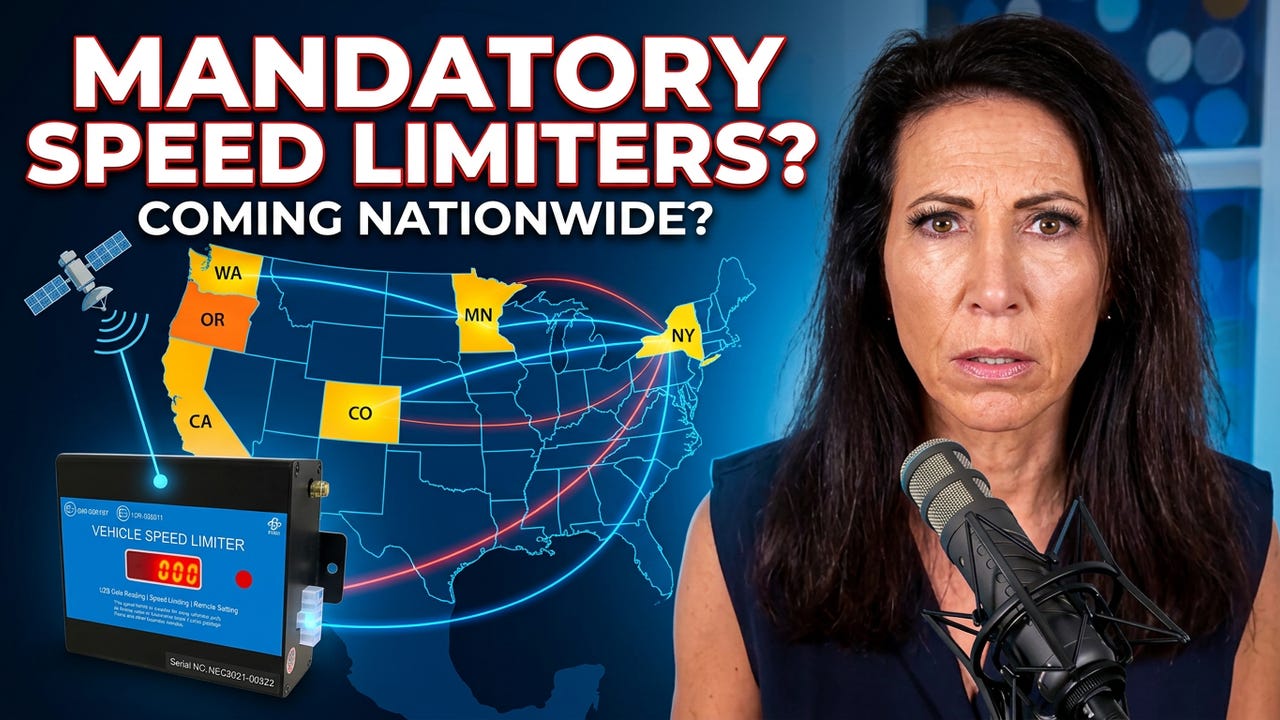
New York politicians are celebrating what they describe as a major victory for public safety. Governor Kathy Hochul recently signed legislation requiring certain repeat speeding offenders to install GPS-based speed-limiting technology in their vehicles. Under the new law, drivers who accumulate 16 or more speed camera violations within a 12-month period can be ordered to install an Intelligent Speed Limiter that prevents their vehicle from exceeding posted speed limits. Those who refuse can ultimately lose their vehicle registration.
At first glance, the proposal sounds reasonable. Most Americans would agree that chronic reckless drivers should face serious consequences. Nobody wants dangerous drivers speeding through school zones or residential neighborhoods. The state is counting on that reaction because it keeps the conversation focused on a small group of offenders rather than the much larger issue this law creates.
The real question is not whether dangerous drivers deserve punishment. The real question is why someone with 16 speeding violations still has driving privileges in the first place.
New York already has speeding laws. It already has fines, insurance penalties, license points, court appearances, and suspension mechanisms. If a driver has accumulated enough violations to be considered such a serious threat that the state now wants to electronically control their vehicle, then why weren’t existing laws sufficient to remove that driver from the road?
That question goes directly to the heart of the issue. Rather than addressing the apparent failure of existing enforcement systems, lawmakers have chosen to create an entirely new layer of technology, surveillance, and government oversight. Instead of asking why repeat offenders remain licensed, they’re asking the public to accept the idea that government should have a greater role in controlling privately owned vehicles.
That’s a significant shift, and it deserves far more scrutiny than it has received.
The legislation relies on Intelligent Speed Assistance technology, commonly referred to as ISA. The system uses GPS data and digital mapping to determine the posted speed limit on a roadway and can prevent a vehicle from exceeding that speed. Unlike traditional enforcement, where a driver is punished after breaking the law, this technology is designed to intervene before the driver can make the decision.
Supporters view that as progress. Many drivers should view it as a warning.
The automotive industry is already moving toward an unprecedented level of connectivity. Modern vehicles collect enormous amounts of information. They receive over-the-air software updates, communicate with manufacturers, monitor driving behavior, and increasingly operate as rolling computers. Consumers have already watched vehicle ownership evolve into something that looks increasingly like a subscription service, with features activated remotely and software determining how products function.
Now government is entering the equation with technology designed to control how a vehicle operates.
That should concern anyone who values personal privacy and consumer rights.
Supporters insist the law applies only to a small group of repeat offenders. That’s true today. The problem is that government programs rarely remain confined to their original scope. Nearly every major regulatory program begins with a narrowly defined target. Politicians identify a group that few people are willing to defend, implement a new policy, and assure the public that the measure will be limited. Once the infrastructure exists, however, expanding it becomes significantly easier than creating it.
That’s particularly true when technology is involved.
Today, the threshold is 16 violations. Tomorrow it could be 10. A few years later it could be tied to insurance classifications, fleet vehicles, or commercial operators. Eventually lawmakers may ask why technology that can reduce speeding among repeat offenders shouldn’t be applied more broadly. Once the public accepts the principle that government can electronically control a privately owned vehicle, the debate shifts from whether such authority should exist to how widely it should be used.
History suggests that expansion is often the rule rather than the exception.
The practical questions surrounding this law are equally troubling. GPS technology is useful, but it is not infallible. Speed limit databases are not always current. Construction zones change. Temporary restrictions appear. Road conditions evolve faster than mapping systems can update. Anyone who has relied on navigation technology knows digital information can be wrong.
What happens when the speed limit database is incorrect? What happens when a road has recently changed from 45 mph to 55 mph but the system hasn’t been updated? What happens when a driver needs rapid acceleration to avoid an accident or escape a dangerous situation?
These are not hypothetical concerns. They are the types of real-world situations automotive engineers consider every day. Yet lawmakers frequently discuss speed-limiting technology as though vehicles operate in a controlled environment where every situation can be anticipated by software. The reality is far more complicated.
Then there is the issue of fairness.
One of the most overlooked aspects of this legislation is its reliance on camera enforcement. Traditional traffic stops identify the driver. Automated camera systems identify the vehicle. Those are not the same thing. Families share cars. Businesses operate fleets. Vehicles are borrowed, rented, and loaned every day. Yet policymakers continue to build enforcement systems around the vehicle itself rather than the individual behind the wheel.
That distinction matters because accountability should be directed at the person responsible for the behavior, not simply the machine involved.
There is also a financial component that deserves attention. Installation costs for these systems can run into the thousands of dollars, with additional fees for monitoring, maintenance, administration, and compliance. Government officials often frame these costs as penalties for offenders, but every new regulatory program creates opportunities for vendors, contractors, software providers, installers, and administrators. Follow the money and an entirely different picture begins to emerge.
The speed limiter itself must be manufactured. It must be installed. It must be monitored. Data must be managed. Compliance must be tracked. Appeals must be processed. Enforcement actions must be administered. Every one of those functions creates a business opportunity for someone.
Whenever government mandates a new technology, there is almost always an industry waiting to benefit from it.
New York is hardly alone in pursuing this approach. Washington State has adopted its own Intelligent Speed Assistance requirements for certain offenders. Virginia and Washington, D.C. have moved in a similar direction, while Illinois lawmakers have advanced proposals involving mandatory speed-limiting technology. What once appeared to be an isolated experiment is rapidly becoming a national trend.
That trend raises an important question. If these states genuinely believe certain drivers are too dangerous to operate a vehicle without government intervention, why not simply suspend their driving privileges? Why create a technological workaround instead of enforcing the penalties already available under existing law?
The answer may be uncomfortable. Suspending licenses removes the driver from the system. Technological monitoring keeps the driver in the system while creating new layers of oversight and control. One approach focuses on accountability. The other focuses on management.
Those are fundamentally different philosophies.
None of this means reckless drivers should escape consequences. They absolutely should not. Drivers who repeatedly endanger others belong in courtrooms, not behind the wheel. Public safety matters, and serious offenders should face serious penalties.
But Americans should be cautious whenever government responds to a failure of enforcement by demanding more surveillance, more monitoring, and more control. The existence of dangerous drivers does not automatically justify every proposed solution.
New York’s “super speeder” law is being sold as a narrowly targeted safety measure. Maybe that’s how it begins. The larger concern is where it ends. Once government gains the authority to electronically regulate the operation of privately owned vehicles, future expansions become much easier to justify.
That’s why the most important question isn’t whether a driver with 16 violations deserves punishment. The most important question is whether Americans are comfortable creating the technological infrastructure that allows government to control how a privately owned vehicle operates.
Today, lawmakers call it a solution for super speeders.
Tomorrow, it may be something much bigger.
You can support me by buying me a cup of coffee and your support! https://www.buymeacoffee.com/laurenfix
Looking for more automotive news? https://www.CarCoachReports.com
Listen to The Drive Car Show - https://www.youtube.com/@thedrivecarshow
Lauren Fix is an automotive expert and journalist covering industry trends, policy changes, and their impact on drivers nationwide. Follow her on X @LaurenFix for the latest car news and insights.


